


OpenAI Model Solves 80-Year-Old Math Problem
Automatically translated
 Admin
OpenAI's AI Model Makes Its Mark in the History of Mathematics
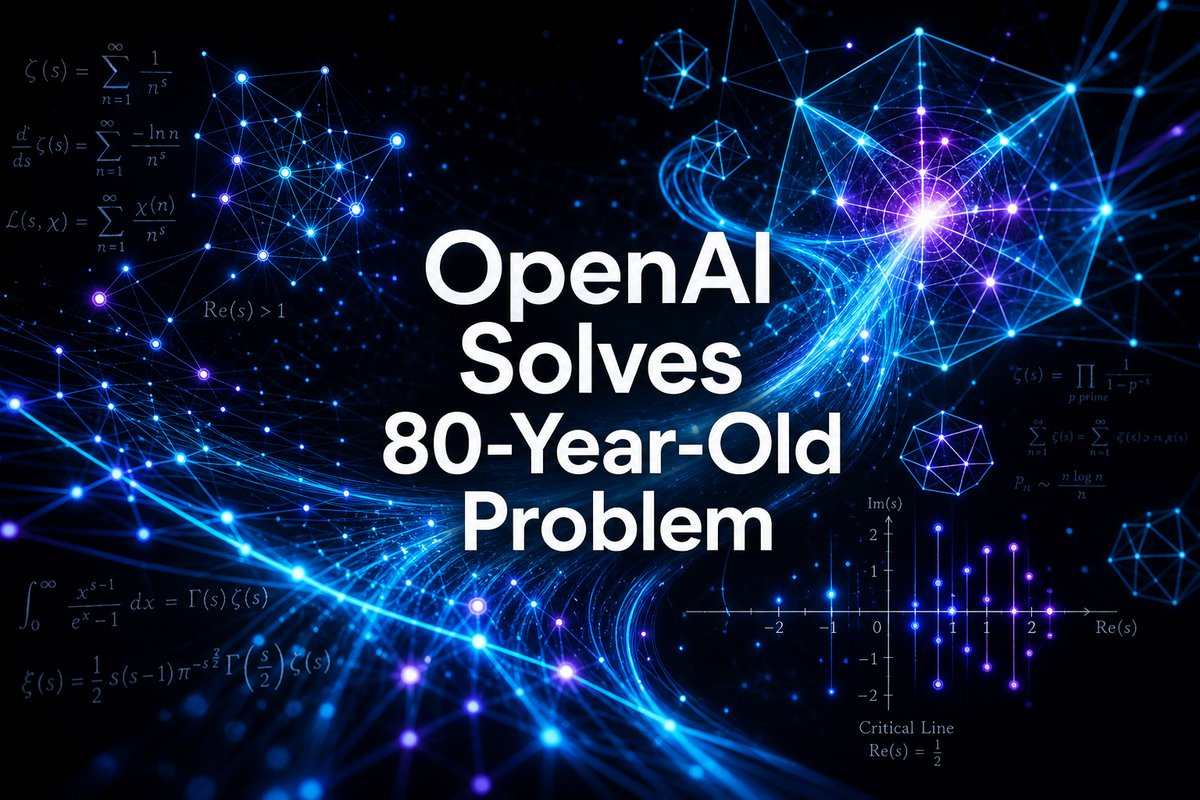
A new turning point is underway in the technology world. An AI model developed by OpenAI has solved the classic mathematical problem known as the Unit Distance Problem, which had gone unsolved for 80 years, and in doing so has disproved a central conjecture in discrete geometry. This achievement shows the power and potential of AI in pure mathematics. Solving complex mathematical problems has long been the domain of mathematicians, but now OpenAI's AI model is also making significant contributions in this field.
The Unit Distance Problem is a very important topic in graph theory and geometry. At its core, it concerns the coloring of graphs formed by connecting points in a plane with equal distances. For many years, mathematicians developed various conjectures about this problem but could not provide a definitive proof. OpenAI's AI model solving this problem shows how far the mathematical reasoning capacity of AI has developed.
What Is the Unit Distance Problem?
The Unit Distance Problem, a part of discrete geometry, is one of the most intriguing questions in mathematics. It was posed in 1945 by the Swiss mathematician Hugo Hadwiger. In essence, it asks how many different colors you need to paint the points of a plane when points that are exactly one equal distance apart are connected.
The Mathematical Definition of the Problem
The Unit Distance Problem is mathematically known as the Hadwiger-Nelson Problem. Two points in the plane are connected when the distance between them is exactly 1 unit. The question asks the minimum number of colors needed to paint these connected points so that no two points at a distance of exactly 1 share the same color. Although it may seem simple, the problem is extremely complex because the number of points on the plane is infinite.
Initially, mathematicians assumed that 4 colors would be sufficient for this problem. However, in 1961, the mathematician Paul Erdős presented an example showing that 7 colors might be necessary. This uncertainty made the problem even harder to solve. For eight decades, scholars tried to offer partial solutions to the problem but were unable to obtain a complete proof.
Earlier Assumptions and Bounds
Over the last century, mathematicians have tried to establish various bounds for the Unit Distance Problem. The chromatic number, estimated to be a value between 4 and 7, was thought to be at least 5 according to research. Starting from different geometric structures, mathematicians have continually updated and narrowed these bounds.
Some researchers have used computers to build various graphs and work toward determining the minimum number of colors. However, even computers have been unable to check all the possibilities on an infinite plane. For this reason, the problem has remained an open question, and a solution has become an achievement deserving recognition in the mathematical community.
The Solution Method of OpenAI's Model
OpenAI's AI model adopted a new approach to solve this problem. By combining deep learning techniques with advanced algorithms from graph theory, the model analyzed the structure underlying the problem. The AI's success is not merely a matter of computing power; it is also evidence of its ability to simulate mathematical intuition.
The Mathematical Reasoning of AI
OpenAI's model was trained on millions of mathematical proofs and academic papers. This training process allowed the model to understand mathematical language and analyze complex geometric structures. The model overturned earlier assumptions by creating a new geometric configuration for the Unit Distance Problem. This shows that AI can not only process existing information but also produce new and original solutions.
The model's success rests on a combination of pattern recognition and combinatorial analysis abilities. Using deep neural networks, the AI identified connections and relationships that human mathematicians had overlooked. This represents an important milestone in AI research and suggests that some future mathematical discoveries may be made by AI.
Technologies and Techniques Used
The transformer architecture and attention mechanisms played an important role in the success of OpenAI's model. Transformer models can process mathematical expressions and geometric concepts more effectively. In addition, the model's combinatorial search capabilities helped it systematically explore the solution space and find an optimal solution.
One of the methods AI uses to tackle problems like this is to divide the problem space into smaller subproblems and solve them. For the Unit Distance Problem as well, the model split the graph into different regions, calculated optimal color assignments for each region, and then combined the results. This modular approach has made solving complex problems more manageable.
The Response of the Mathematical Community and Its Significance
OpenAI's achievement has caused a major stir in the international mathematics community. Mathematics departments at universities and research institutes are following this development closely, and intense discussions are taking place about the role of AI in mathematics. Many mathematicians say that such achievements show that humans and AI can collaborate.
Academic Implications
After this solution, the role of AI in mathematical research is expected to be taken more seriously. New projects and funding for AI-supported mathematical research are being allocated at universities. Mathematicians now have the option of collaborating with AI when working on complex problems. This could significantly speed up mathematical research and pave the way for the discovery of new theorems and proofs.
Changes are also expected in education. Mathematics students may need to learn not only classical problem-solving methods but also how to work effectively with AI tools. This presents both an opportunity and a challenge for the development of mathematical thinking.
New Research Areas and Questions
OpenAI's success has encouraged mathematicians to ask new questions and conduct deeper research. The solution to the Unit Distance Problem has raised the question of which other open problems might be solved with similar methods. Speculation has started about whether AI could solve some of Hilbert's 23 problems and famous open questions such as the Riemann Hypothesis.
In addition, mathematicians are trying to understand not only whether OpenAI's solution is correct, but also why it works and which fundamental mathematical principles it relies on. This raises an important question about treating AI as a "black box" and about its explainability.
Mathematical Problems Solved by AI
The solution to the Unit Distance Problem is not the first example of AI succeeding in mathematics. In recent years, AI has made important contributions in various areas of mathematics. In particular, after DeepMind's successes with AlphaGo and AlphaZero, expectations about AI's abstract thinking and problem-solving abilities have grown.
Earlier AI Achievements
In knot theory, DeepMind enabled AI to discover an unusual invariant. This achievement is an indication that AI can imitate mathematical intuition. Similarly, AI models have solved various combinatorial optimization problems and provided practical benefits in engineering applications.
Progress has also been made in mathematical analysis. AI helps mathematicians in solving differential equations, in integral calculations, and in numerical analysis. Machine learning algorithms are widely used to predict mathematical functions and analyze complex datasets.
Automation of Mathematical Proofs
An important aspect of OpenAI's success is the potential to automate the process of writing mathematical proofs. Formal mathematics and proof assistant tools (such as Lean and Coq) have made mathematical proofs verifiable by computers. When combined with these tools, AI could significantly accelerate the process by which mathematicians find proofs.
These developments offer new possibilities for encoding mathematical knowledge and having it processed by machines. In the future, a more symbiotic relationship between mathematicians and AI systems is expected: humans will provide intuition and creativity, while AI will offer computing power and systematic analysis.
Artificial Intelligence and Mathematics: A Look at the Future
OpenAI's solution to the Unit Distance Problem shows that the relationship between mathematics and AI is a dynamic and continuously evolving process. It is hard to predict how far this collaboration can go and what new discoveries it may make, but its potential appears enormous.
Ethical and Philosophical Issues
The ability of AI to produce mathematical proofs raises deep ethical and philosophical questions. When a proof is found by AI, does it contribute to mathematical knowledge on an equal level? What is the value of human mathematical creativity? These questions are still being debated in the worlds of science and philosophy.
The question of whether mathematical discoveries should be open source or controlled for commercial purposes has also come up. The fact that this achievement came from a commercial organization has sparked debate about access to and use of mathematical knowledge.
Mathematics Education and Employment
The growing role of AI in mathematics may affect mathematics education and the employment outlook for mathematics professionals. In the future, the role of mathematicians may shift from being pure problem solvers to people who guide, question, and interpret the results of AI systems. This transition will require education systems to adapt as well.
Young people who want to build careers in mathematics may need to know not only mathematical knowledge but also computer science, data analysis, and artificial intelligence. University curricula may need to be restructured to reflect these changing dynamics.
International Research and Collaboration
OpenAI's achievement has increased both collaboration and competition in the international mathematical research community. Research organizations in different countries are investing in using AI to solve mathematical problems. In Turkey as well, university computer science and mathematics departments have begun considering opportunities to take part in such projects.
Conclusion and Reflections on the Future
OpenAI's AI model solving the Unit Distance Problem, which had gone unsolved for 80 years, is an important milestone in the history of mathematics and science. This achievement has demonstrated the potential of AI in pure mathematics and shown that humanity has new tools for tackling complex problems. The model has shown the capacity not only to process numbers but also to imitate mathematical intuition and creativity.
This development has the potential to bring about a revolution not only in the mathematical world but in all scientific research methods. Open problems in physics, new molecular design in chemistry, and structural problems in biology and genetics: in all these fields, AI is getting ready to become a strong partner to mathematicians and scientists.
However, alongside these achievements come important issues such as ethics, explainability, and access to knowledge. The mathematical community must carefully evaluate the role of AI and ensure that these tools are used as instruments of humanity's scientific progress. The future may be a period in which humans and AI collaborate effectively and mutually support each other's strengths. OpenAI's achievement is one of the first important steps on that path.
AdminÇin Mahkemesi: LLM İnsan Yerine Geçemez Kararı


Yapay Zeka Pazarlama İçerik Üretimini Dönüştürüyor!